-:
Hindu Temples :-
Lord Shiva Temples
Kailash Temple, Ellora
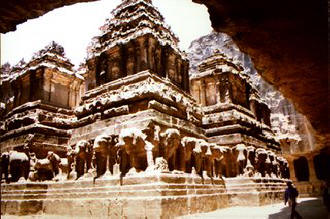
Kailash Temple is situated at
Ellora and is believed that it was constructed by excavating approx.
200,000 tones of rock and is possible the world's largest monolithic
structure. Representing Shiva's Himalayan home, the temple is exquisitely
sculpted and is considered as one of the most astonishing 'buildings' in the
history of architecture. A crowning glory of the art, Kailash temple at
Ellora is indeed unique. Instead of carving down into the face of a cliff
and creating underground halls which had been the practice, the
sculptors/architects set aside all convention and created a full temple,
identical in every detail to a structural, 'built-up' example, by carving
vertically down into the living rock.
Design & Construction
The scheme of the Kailash temple is basically divided into four main parts:
the body of the temple itself, the entrance gateway, an intermediate nandi
shrine and the cloisters surrounding the courtyard. Much of the imposing
character of the main shrine is due to its substantial plinth, which on
first examination seems to be a floor by itself. Above and below this, the
sub-structure is heavily molded, while the central space is occupied by a
frieze of elephants and lions.
The Kailash temple is not only the single largest work of art executed in
India, but as an example of rock-cut architecture it stands unrivaled. One
gradually becomes aware of the stupendous labor that it involved (over a
hundred years), and finally, the sculpture that adorns it. Standing within
its walls, one cannot help but be aware of the spiritual energy that went
into its creation - a jewel hewn out of the rock itself.