Gurus & Saints of India
Sant Tukaram
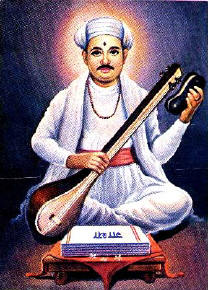
Tukārām was a prominent Marathi Sant and religious poet in the Hindu tradition in India.
He was born and lived most of his life in Dehu, a town close to Pune city in Mahārāshtra, India. He was born to a couple with the family name "Moray" - the descendent of the Mourya Clan (Āmbile) and first names Bolhobā and Kanakāi. Through a tradition in India in bygone days, Tukaram's family name is rarely used in identifying him. Rather, in accord with another tradition in India of assigning the epithet "sant" to persons regarded as thoroughly saintly, Tukaram is commonly known in Maharashtra as Sant Tukaram .
Scholars assign various birth years to Tukaram: 1577, 1598, and 1608 CE. The year of Tukaram's death --1650 CE-- is much more certain.
Tukaram's first wife, Rakhumābāi, had died in her early youth. Tukaram and his second wife, Jijābāi (also known as Āvali), had three sons: Santu or Mahādev, Vithobā, and Nārāyan.
Religious life and poetry
Tukaram was a devotee of Lord Vittala (or Vithobā) --an incarnation of Lord Krishna, who in turn, was an incarnation of Lord Vishnu-- in Hinduism.
Tukaram is considered as the climactic point of the so-called Bhāgawat Hindu tradition, which is thought to have begun in Maharashtra with Nāmdev. Dnyāneshwar, Nāmdev, Janābai, Eknāth, and Tukaram are revered especially in the wārakari sect in Maharashtra.
Whatever information about the lives of the above saints of Maharashtra comes mostly from the works Bhakti-Wijay and Bhakti-Leelāmrut of Mahipati. Mahipati was born 65 years after the death of Tukaram, (Tukaram having died 50 years, 300 years, and 353 years after the deaths of Ekanath, Namdev, and Dnyaneshwar, respectively.) Thus, Mahipati undoubtedly based his life sketches of all above "sants" primarily on hearsays.
Tukaram's public relgious discourses used to be mixed, by tradition, with poetry, which included some of his own compositions. His discourses focussed on day-to-day behavior of human beings, and he emphasized that the true expression of religion was in a person's love for his fellow human beings rather than in ritualistic observance of religious orthodoxy, including mechanical study of the Vedās. His teachings encompassed a wide array of issues, including the importance of the ecosystem. Tukaram worked for his society's enlightenment in the "warakari" tradition, which emphasizes community service and musical group worship.
Like Namdev, Janabai, and Eknath, Tukaram wrote in Marathi a large number of devotional poems identified in Marathi as abhang . A collection of 4,500 abhang known as the Gāthā is attributed to Tukaram. Mantra Geetā, a Marathi translation in abhang form of the Sanskrit Bhagavad Geetā, is also attributed to him. It is an interpretation of Geeta from a Bhakti -devotional-- perspective.