Gurus & Saints of India
Sant Kabir
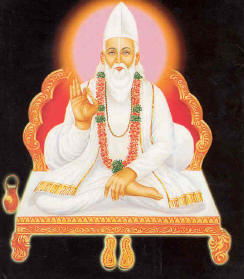
Kabir is not easily
categorized as a Sufi or a Yogi -- he is all of these. He is revered by
Muslims, Hindus, and Sikhs. He stands as a unique, saintly, yet very human,
bridge between the great traditions that live in India. Kabir says of
himself that he is, "at once the child of Allah and Ram."
He was born in Varanasi (Benares), India, probably around the year 1440
(though other accounts place his birth as early as 1398), to Muslim parents.
But early in his life Kabir became a disciple of the Hindu bhakti saint
Ramananda. It was unusual for a Hindu teacher to accept a Muslim student,
but tradition says the young Kabir found a creative way to overcome all
objections.
The story is told that on one particular day of the year, anyone can become
a disciple by having a master speak the name of God over him. It is common
for those who live near the Ganges to take their morning bath there in the
sacred waters. The bhakti saint Ramananda took his bath as he did every day,
by arising before dawn. On this special day, Ramananda awoke before dawn and
found his customary way down to the steps of the Ganges. As he was walking
down the steps to the waters, a little hand reached out in the predawn
morning and grabbed the saint's big toe. Ramananda taken by surprise and he
expressed his shock by calling out the name of God. Looking down he saw in
the early morning light the hand of the young Kabir. After his bath in the
early light he noticed that on the back of the little one's hand was written
in Arabic the name Kabir. He adopted him as son and disciple and brought
him back to his ashrama, much to the disturbance of his Hindu students, some
of whom left in righteous protest.
It is said that what really made this meeting the most special is that in
this case it, was only after Kabir's enlightenment that Ramananda, his
teacher, became enlightened.
Not much is known about what sort of spiritual training Kabir may have
received. He did not become a sadhu or rununciate. Kabir never abandoned
worldly life, choosing instead to live the balanced life of a householder
and mystic, tradesman and contemplative. Kabir was married, had children,
and lived the simple life of a weaver.
Although Kabir labored to bring the often clashing religious cultures of
Islam and Hinduism together, he was equally disdainful of professional piety
in any form. This earned him the hatred and persecution of the religious
authorities in Varanasi. Nearing age 60, he was denounced before the king
but, because of his Muslim birth, he was spared execution and, instead,
banished from the region.
He subsequently lived a life of exile, traveling through northern India with
a group of disciples. In 1518, he died at Maghar near Gorakhpur.
One of the most loved legends associated with Kabir is told of his funeral.
Kabir's disciples disputed over his body, the Muslims wanting to claim the
body for burial, the Hindus wanting to cremate the body. Kabir appeared to
the arguing disciples and told them to lift the burial shroud. When they did
so, they found fragrant flowers where the body had rested. The flowers were
divided, and the Muslims buried the flowers while the Hindus reverently
committed them to fire.