Hindu Gods and Goddesses
One of the Trinities
Shiva - Lord of Destruction
Siva, the last of the Trinities is the God of destruction & he is assisted in this by his consort Parvathi, the Goddess of disintegration. Parvathi represents sakthi, to disintegrate perishable matter, in the absence of which true and complete destruction by Siva becomes impossible. This could possibly be the meaning of the idea that Siva becomes nothing in the absence of Sakthi.
|
|
Siva in his human form is worshipped as the Utsava murthi, taken out on processions.
Siva Lingams worshipped in temples are mostly made of stone & consists of three parts. The lowest portion in the shape of a square symbolises Brahma (the God of Creation). The middle part in the shape of an octagon symbolises Vishnu (the God of Maintenance). These two portions are embedded inside a pedestal. The cylindrical portion projecting from the pedestal symbolises Shiva (the God of Destruction).
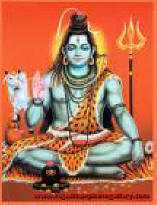
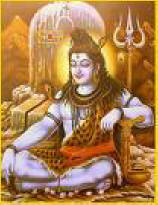
Siva resides high up on snowy mountain ranges. Image of Siva in his physical form presents him as a soothing meditative figure. His ornaments are not gold & precious stones.
|
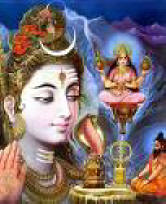
He wears a necklace made of skulls signifying his role as destructor. He has snakes coiling all over his body & his hair is matted and long extending over the whole sky & space. The crescent moon adorns his crown, signifying his control on the time cycle.(Amavasay & Pournami). He smears his body with ashes & wears a tiger skin and elephant skin. He has a third eye on his forehead which is the source of knowledge & wisdom. The holy Ganges is imprisoned in his flowing locks. In his two arms he holds the Trisulam (the three prongs representing the three gunas of sattva, tamas & rajas) in one & Damaru in the other. His vahana is the Nandi, who is also his chief disciple to whom Siva passed on all his immense knowledge in arts. |
The above description should convey him as an angry & destructive image, yet being the source of all knowledge he is often in a meditative pose with half closed eyes looking out into the universe as well as in to his inner self, signifying that his act of destruction is in itself an act of creation for in the absence of destruction there can be no creation.
Other names &
manifestations of Lord Siva
Nataraja
Dakshinamurthi
Lingodhbava
Haryardhamurthi
Ardhanareeswara
Bhikshatana