Karwa Chauth Vrat
|
|
Karwa Chauth is a
popular fasting in Hinduism and is mainly
 observed in
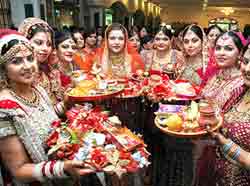
Karwa Chauth is a fast undertaken by married Hindu women who offer prayers seeking the welfare, prosperity, well-being, and longevity of their husbands. It is said to have an extraordinary observance rate among married Hindu women. Following a bath early in the morning, well before dawn, the woman adorns new clothes and partakes of a meal of very select grains and fruit. For the remainder of the day, the woman is bound to abstain from food and even water, though the more strict rules of observance are not always kept. In the text-book version of this fast, various items including a karwa, an earthen pot with a spout, are collected and worship is offered to Siva and Parvati.
Rituals : It is celebrated on the chaturthi tithi after the full Moon in the month of kartik in the Hindu calendar. According to the religious scriptures like Dharma sindhu, Nirnay sindhu and other shastra that governs rules of when to observe festival says, “Karwa Chauth to be observed at moonrise (chandrodaya vyapini) and poorvaviddha, best if its tritiya viddha. If visible during both days take the first one, if not visible on both days then take the second one”.
-
Queen Veeravati - Long time ago, there lived a beautiful girl by the name of Veeravati. She was the only sister of her seven loving brothers, who was married to a king. On the occasion of the first Karva Chauth after her marriage, she went to her parents' house. After sunrise, she observed a strict fast. However, the queen couldn't stand the rigors of fasting and was desperately waiting for the moon to
 rise. The seven brothers, who loved her dearly, were very disturbed
watching the distress of their sister and decided to end her fast by
deceiving her. Then the brothers reflected a mirror through Pipal tree
leaves. The sister, taken it as moonrise, broke the fast and took food.
However, the moment the queen ate her dinner, she received the news that
her husband, the king, was seriously ill. She did not keep the fast
properly. When Veeravati begged forgiveness, Goddess Parvati granted that
her husband would revive only when she completes her fast under strict
conditions. The queen observed the fast and thus revived the life of her
husband
rise. The seven brothers, who loved her dearly, were very disturbed
watching the distress of their sister and decided to end her fast by
deceiving her. Then the brothers reflected a mirror through Pipal tree
leaves. The sister, taken it as moonrise, broke the fast and took food.
However, the moment the queen ate her dinner, she received the news that
her husband, the king, was seriously ill. She did not keep the fast
properly. When Veeravati begged forgiveness, Goddess Parvati granted that
her husband would revive only when she completes her fast under strict
conditions. The queen observed the fast and thus revived the life of her
husband -
There is the story of the Satyavan and Savitri. When Lord Yama, came to procure Satyavan's soul, Savitri begged him to grant him life. When he refused, she stopped eating and drinking and Yamraj finally relented. He granted her, her husband's life.
-
According to another legend, a woman named Karva was deeply devoted to her husband. One day while bathing, he was caught by a crocodile. Karva came running and bound the crocodile with a cotton yarn. She then went to Yama, the Lord of the death, and requested him to send the offending crocodile to hell. When Yama refused, she threatened to curse him. Afraid of the power of a devoted wife, Yama readily accepted and sent the crocodile to Yamalok or hell, and blessed Karva's husband with long life. To this day, Karva Chauth is celebrated with great faith and belief.
-
Mahabarata - The earliest reference of a Karva Chauth can be found in the great epic of Mahabharata. As per Mahabharata, Arjun, a supreme warrior and one of the Pandavas, went to the Nilgiri Hills to offer his prayers and worship the gods. Draupadi, wife of the Pandavas, was accompanying him. On the way, Draupadi was struck with fear believing that she was alone in the forest with no one to protect her. As she treated Lord Krishna as her Brother, she invoked him to appear before her and help her out of this grave situation. Lord Krishna reminded her that on an earlier occasion, when Goddess Parvati had sought Lord Shivas guidance under similar circumstances, she had been advised to observe the fast of Karva Chauth. Draupadi followed the instructions and observed the fast with all its rituals. Consequently, the Pandavas were able to overcome their problems. On this day, fasting women listen to Karva Chauth legends with rapt attention.
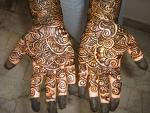
A Day Before: The pooja preparations start a day in advance. There is huge excitement a day before the festival as women make elaborate preparations to dress up elaborately for the occasion. The Married women buy bangles, bindis, apply mehndi (Hena tattos) on their hand and feets
Puja
Thali : Nicely decorated karva chauth thali has its own role in your
karva chauth puja. it contains items like sacred water, dry fruits like
almonds, pista, o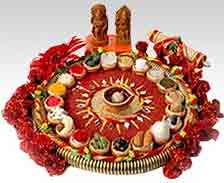 il,
vermillion, earthen clay pots, and diyas along with variety of sweets in
katoris. Th art of creating attractive thalis for puja also contains
ritualistic decoration like rangoli and alpana. You can also prepare your
puja thali with floral designs using flowers, leaves, color and multicolored
pulses.
il,
vermillion, earthen clay pots, and diyas along with variety of sweets in
katoris. Th art of creating attractive thalis for puja also contains
ritualistic decoration like rangoli and alpana. You can also prepare your
puja thali with floral designs using flowers, leaves, color and multicolored
pulses.
Simple Way :- The simple way to fast on the day is to wake up early have a bath, offer daily prayers and consume some food before sunrise. In the evening, pray to Goddess Parvati, wait for the moonrise. Have a look at the moon and enjoy a good dinner with husband and family. Remember, all rituals are meant for the satisfaction of the ego, Gods don’t need rituals. Santana Dharma teaches to get over all rituals and understand the Brahman – the Supreme Force present in you and in everything
Traditional Way :- The traditional way contains several steps as follows.
On the day, married women wake up before sunrise and take bath and offer their usual prayers. They then consume food. Foods consumed on the day are those which can help in maintaining the fluid level of the body - milk, fruits, juice, tea or coffee. Freshly prepared breakfast like puri and aloo is also consumed. Non-vegetarian food is avoided on the day. No food is consumed after sunrise.
Women spend the day visiting friends and relatives. Many make use of the day to apply ‘henna’ on their palms and feet. The women dress in beautiful saris and other traditional garments. Working women head to work or take leave on the day.
An important ritual on the day is the ‘baya’ send by the mothers for their daughters. The Baya (gift to the mother-in-law) usually consist of mathris, puas, halwa, clothes and some small amount of cash. This ritual and the items vary from region to region but in most places a ‘baya’ is send by mothers to their daughters.
The most important part of the ritual is the Karva, an earthen pot with an outlet on the side and open from the top with a lid. If Karva is not available anything any utensil resembling Karva is used.
The preparation for the puja starts early evening mostly by 1700 hrs. The room for puja depends on the number of people invited. The puja place is decorated with ‘kharia matti.’ A ‘chowk’ is decorated on the floor and atop it a seep chowk is decorated with ‘aipun.’ The chowk is placed against the wall and on a decorated ‘patta,’ Goddess Parvati is installed. This is the traditional form of decorating the puja room for Karva Chauth.
A simple method is to install the picture or an idol of Goddess Parvati in the usual Puja room or at the designated place.
An hour before moonrise those who have undertaken the vrat or participating in the puja gather in the puja room.
The karva is decorated with kharia, aipun and roli. A red thread is tied around the neck of the karva. The karva is filled with water (a little) and seven broken pieces of pua. The thali consists of puas, puris, dry fruits, water, halwa and cash. The thali is kept over the karva. The items on the thali vary from region to region and also depend on what the person performing puja likes to have on it. Now each woman does the puja. This ritual is known as mansana.
Women dress neatly and colorfully for the puja and apply sindhoor on the maang. The puja is quite simple. First, the person performing the puja applies a roli teeka or sindhur on the idol or forehead of Goddess Parvati. Then she dips the third finger of the right hand in water and sprinkles it with the help of thumb three times on the deity. The same ritual is repeated with aipun and roli. Finally, rice is showered on the deity and a little rice is kept in the hand. All the participating women can do this puja.
One woman narrates the story of Karwa Chauth and others listen with the rice in the hand.
At the end of the story, each woman exchanges her karva with her friend. The woman giving the karva says’ O Suhagan take my karva.’ The one receiving says O Suhagan give your Karva.’ The roles are then reversed.
After this each woman present perform the baya
manasana. The woman takes rice in the left hand and adds little water to it.
The edge of the ‘pallu’ is taken in the right hand the index finger is
dipped in the left hand. Both the hands are taken around the karva and the
water is poured on the side of the karva. An elderly woman chants the
mantra. The whole ritual is repeated a second time without the mantra.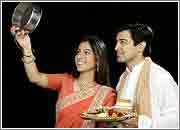
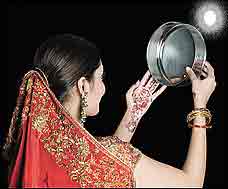
Then when the moon is sighted, the reflection of the moon is seen in the water in the puja thali or through a sieve. The woman holds a lamp in the left and offers water to the moon – pouring water on the ground seven times and also throwing seven broken pieces of freshly broken puas.
The fast is broken by eating a puja broken into ten pieces and by drinking water in between.
Important Note :
Anyone
who suffering from any disease or are taking medicines, please consult your
doctor before undertaking the fast.