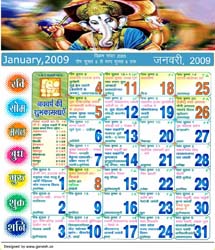
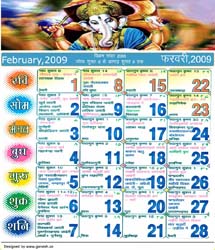
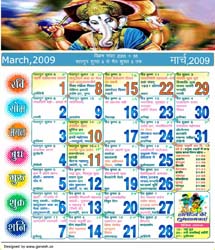
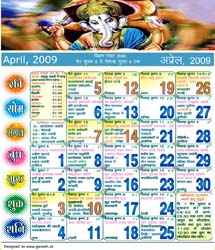
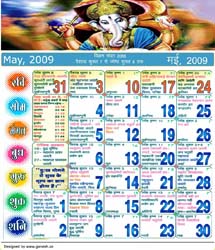
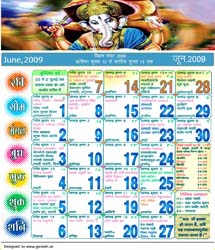
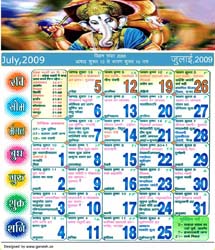
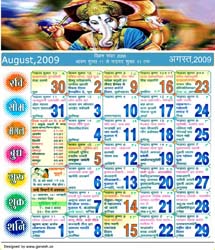
List of Hindu Festivals
in Year 2009
The Indian calender is ingeniously
based on both the sun and the moon; it uses a solar year but divides it into 12
lunar months. A lunar month is precisely 29 days 12 hours 44 minutes and 3
seconds long. Twelve such months constitute a lunar year of 354 days 8 hours 48
minutes and 36 seconds. To help the lunar months coincide with the solar year,
the practice of inserting an intercalary (extra) month arose. So 60 solar months
= 62 lunar months. Hence an extra month, called the Adhik Mas, is inserted every
30 months i.e. every 2 ½ years.
Lunar days in the Indian calendar
are called tithis. They are calculated using the difference of the longitudinal
angle between the position of the sun and moon. Because of this, tithis may vary
in length. Consequently, the tithi may or may not have changed by the time the
day has changed at sunrise. And that is why we find at certain times a tithi
being omitted, and at certain times, two consecutive days sharing the same tithi.
In the Indian calendar, seasons
follow the sun; months follow the moon; and days, both the sun and the moon. The
era in the Indian calendar is called the Vikram Era, or the Vikram Samvat, which
began in 57 BCE. To calculate the corresponding year of the Common Era, 57 years
should be subtracted from the Indian year if the date falls between the
beginning of the Indian year and the end of the Western year i.e. between Kartak
sud 1 and 31 December. If the date falls between the beginning of the Western
year and the end of the Indian year i.e. between 1 January and Aso vad 30, then
only 56 years should be subtracted.
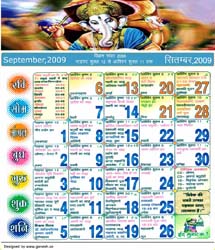
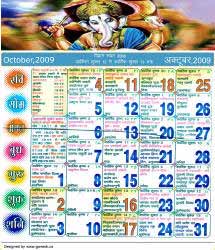
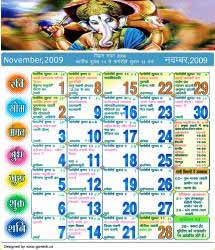
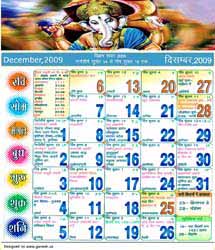
We present the 2009 year calendar
with the tithis, dates and holy festivals of India.